what octane of gas to run in 2018 crv 1.5 turbo
From the July 2019 consequence of Machine and Commuter.
The tendency that'due south changing the way America moves is far subtler than whatever practiced click-generating headline would have you believe. Electric vehicles are decades away from showing up en masse at country-music concerts, canton fairs, and Tractor Supply parking lots. True go-anywhere autonomy will evidence as elusive as finding satisfying vegan bacon. The tendency we're actually living is the story of smaller engines working harder, in everything from family crossovers to six-figure autobahn barges. Downsized but hardly diminished, many of these shrunken engines are more powerful than their predecessors, thanks to turbocharging, variable valve timing and elevator, direct injection, and the avant-garde reckoner controls tying these all together.
Today's engines are so sophisticated that fifty-fifty mainstream nonperformance vehicles can do good from running on higher-octane premium fuel. Vehicles such as the Ford Escape and Mazda 6 are advertised with power figures fabricated on 93-octane fuel, although both companies are quick to note that these vehicles will happily run on 87. What automakers rarely say is what, precisely, are the benefits of paying for premium. That ambiguity tin be expensive. Premium gas tracked at $0.59 more per gallon than regular unleaded as of this writing. In a vehicle averaging 25 mpg and traveling 15,000 miles a year, that amounts to a $354 annual surcharge for using the more than expensive stuff.
Raising the octane rating (likewise known every bit the anti-knock alphabetize) doesn't change the energy content of a gallon of gasoline. A higher octane rating indicates greater resistance to knock, the early on combustion of the fuel-air mixture that causes cylinder pressure level to fasten. When college-octane fuel is flowing through its injectors, the engine controller tin can take reward of the elevated knock threshold and dial in more ambitious timing and college boost pressures to improve performance.
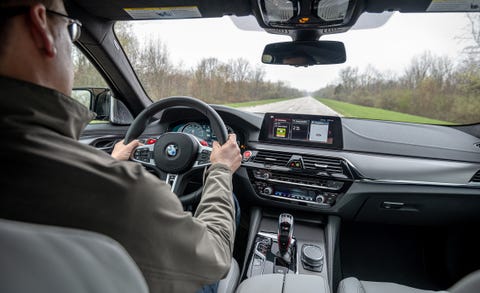
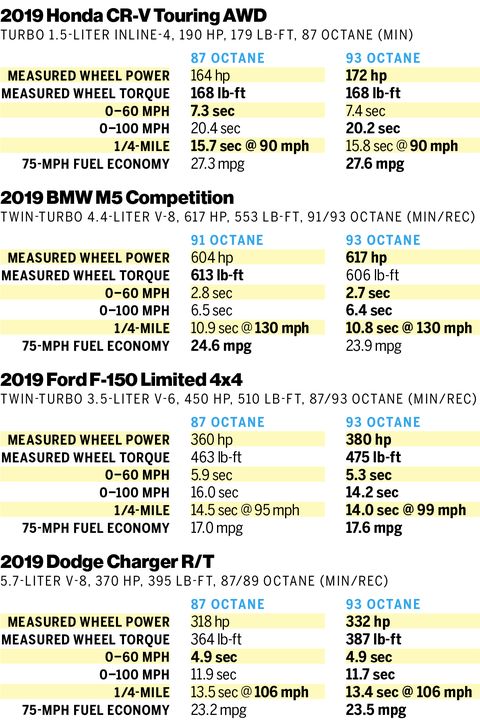
To sympathise how higher octane affects acceleration and efficiency, we assembled a four-wheeled quartet sampling a wide spectrum of the market. The Honda CR-V stands in for a swath of affordable crossovers and sedans with its turbocharged 1.v-liter inline-four. At the intersection of effortless speed and opulent luxury, the BMW M5 Competition squeezes 617 horsepower from its twin-turbo 4.4-liter V-8. Ford's F-150 is America'southward best-selling vehicle and is equipped here with its most stiff engine, the 450-hp EcoBoost twin-turbo 3.v-liter V-6. A Contrivance Charger R/T with the Hemi 5.vii-liter V-8 carries the flag for naturally aspirated engines.
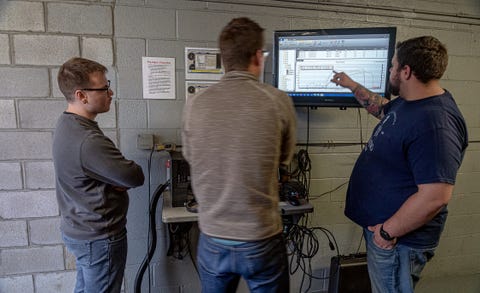
We performed dispatch runs, 200-mile fuel-economy loops at 75 mph, and dynamometer pulls, running each vehicle on two different fuels and completely draining the tanks in between. The differences likely would have been exaggerated by extreme summer rut, which exacerbates engine knock, but we sniffed out differences even with the engines huffing cool midwestern spring air.
Honda CR-V
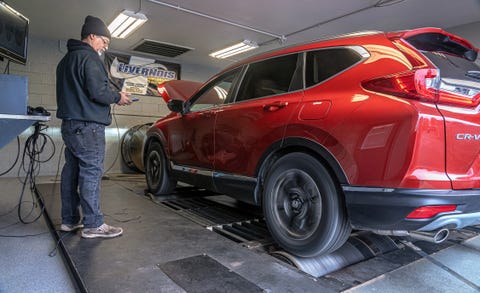
Fifty-fifty as it's sucking down as much every bit 18.5 psi of boost, the CR-5'due south 1.v-liter inline-four isn't interested in 93 octane. Honda asks for 87 octane and makes no claims that raising the fuel octane will elevator performance. Based on our testing, premium fuel might as well not be in the CR-5's world.
Nosotros could see this coming. During a like Machine and Commuter examination 18 years ago, an Accordance powered by a three.0-liter V-vi made more power and accelerated quicker on regular fuel than on premium. The modern CR-Five, with one-half the deportation but rated at just ten fewer ponies, makes the same argument: don't waste product your money on premium. Switching from 87 octane to 93 yielded a 7-hp gain on the dynamometer, just that advantage was lost in the noise at the runway. There, the CR-V'southward nothing-to-threescore-mph and quarter-mile times both tracked a 10th of a second slower on the expensive stuff. While fuel economic system at 75 mph ticked up from 27.3 mpg to 27.6 mpg on premium, that's a 1 percent improvement for a 21 percent higher cost.
Honda built its reputation on a line of unassuming, egalitarian motorcycles in the '60s. Nearly 60 years subsequently, the company's identity is still predicated on the same sensible and pocket-sized ethic, right downwardly to the fuel that you put in the tank.
BMW M5 Competition
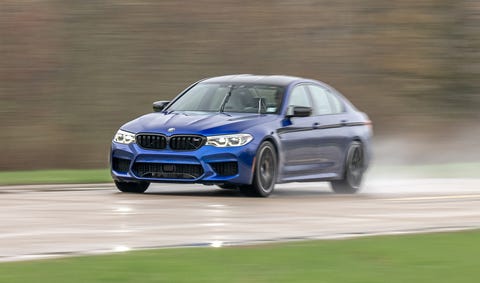
The mere idea of pumping regular unleaded into this $129,595 intercontinental ballistic missile felt wrong. BMW explicitly warns most engine damage from doing so, and while that seemed unlikely in such mild temperatures, using the cheap stuff would have been wildly out of touch with what an owner would do (at to the lowest degree until this M5 reaches its fourth possessor old in 2036). BMW requires 91-octane fuel at a minimum, with 93 recommended, and so we did but that, switching betwixt the common forms of premium gas depending on which state you're in. Are Californians, with their watered-down premium, leaving something on the tabular array? We wanted to know.
The dyno results shocked us. Non considering of the 13-hp difference between 91 and 93 octane. No, that delta was in line with expectations. Our jaws were left hanging past just how much power and torque we measured. On either fuel, the über 5-series is seriously underrated. While BMW claims 617 horsepower at the crank, the dyno reports it makes that much at the wheels (after driveline losses) on 93-octane premium. And both fuels produced significantly more than torque than BMW'south advertised 553 lb-ft.
The higher-octane fuel trimmed a single 10th of a 2d beyond all of the M5'southward acceleration times. That results in a time-angle ii.vii-2nd slingshot to threescore mph and x.8 seconds through the quarter-mile and lands this 5-seat, 4246-pound four-door squarely in the realm of supercars. The BMW also claimed the largest fuel-economy margin in the examination, but the 0.7-mpg difference favored the lower octane. The M5 Competition stands as proof that the octane rating does make a difference, although in the case of these two premium fuels, if you're forced to use 91 octane, you lot're hardly missing out.
Ford F-150
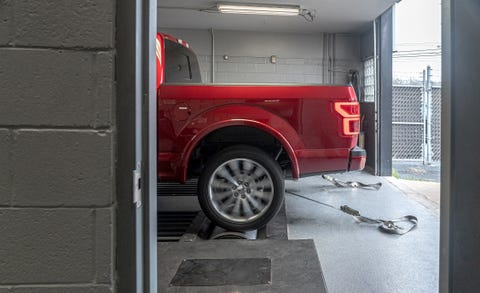
At 128.7 horsepower per liter, the F-150's loftier-output Five-half dozen engine is more ability dumbo than a Porsche 911 Carrera's twin-turbo flat-vi. Naturally then, the Ford hauls donkey as effortlessly as it hauls a half-ton of manure. When fed 93 octane, this 5594-pound, cocky-propelled wheelbarrow volition crash 60 mph in v.3 seconds.
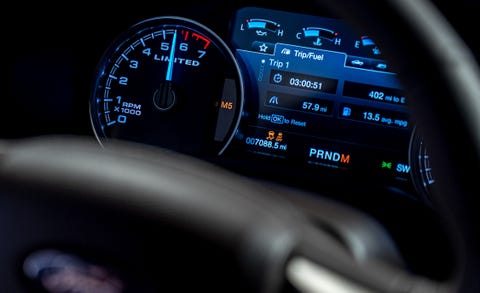
Power at the wheels dropped from 380 to 360 horsepower with the change from 93 to 87 octane. That difference seemed to grow, and we could even feel it from the driver's seat at the test track. Compared with premium fuel, regular feed sapped the F-150's urgency both leaving the line and in the meat of the tach sweep. The rush to lx mph softened to a still-baking v.9 seconds, and the quarter-mile stretched from 14.0 to fourteen.five seconds, with trap speed falling 4 mph. Tapped into the Ford's Tin can bus, we recorded a peak boost pressure level roughly 1.9 psi lower during dispatch runs on regular gas, downwards more than 10 per centum compared with the 18.1-psi top on premium. The high-octane gas as well helped when soft-pedaling the accelerator, elevating 75-mph fuel economy from 17.0 to 17.half-dozen mpg. That won't make a financial case for running 93 octane, but and so you didn't buy the expensive engine as a rational choice. You lot tin can think of this EcoBoost engine's more aggressive high-octane melody as a sort-of sport mode that can be switched on or off with every fill of its 36.0-gallon tank.
Contrivance Charger R/T
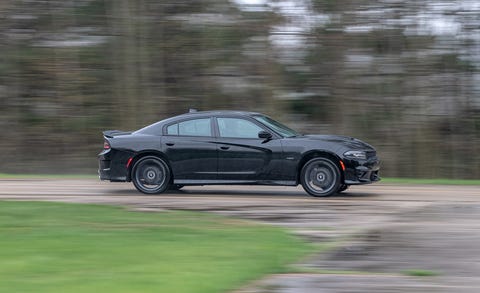
We e'er causeless that mid-grade fuel existed chiefly to bilk a few more dimes from the blazon of people who ask the dealer to undercoat their car. Turns out it's also for owners of Fiat Chrysler's Hemi five.vii-liter V-eight, as the company recommends 89-octane fuel for this engine. With no mention of that on the fuel-filler door, though, a driver would take to read the transmission to know. And we don't run across that happening in the case of this particular Charger R/T, which was cherry-picked from the Detroit airport rental lot for our examination. With just 600 miles on the odometer and looking every bit if it had already been hand washed with eighty-grit sandpaper a half-dozen times, this Charger is unlikely to ever gustatory modality 93 octane again.
Oh well. The Charger's manual says 87 octane will provide "satisfactory fuel economic system and performance." In our testing, "satisfactory" proved to exist nearly identical to how the machine performed with premium gas. Similar to the BMW, the Dodge's gains on the dyno (xiv horsepower and 23 lb-ft of torque) translated into negligible improvement in our real-world dispatch testing. Saddled with elephantine heft and eager to spin its rear all-season tires at launch, the Charger posted the aforementioned 4.9-second hustle to 60 mph on 87 and 93 octane. At triple-digit speeds, the college power on 93 octane gave the Charger an advantage measured in tenths of a second. The Contrivance also posted a 0.three-mpg improvement on premium with its average of 23.5 mpg. Simply as important, the bellicose roar of the iron-block Hemi and the Charger's ability to reduce its rear tires to jungle-gym ground cover are unaffected past the fuel in the tank.
While Ford'due south EcoBoost F-150 stands out as an obvious exception, the Dodge Charger's numbers make for a tidy summary of our findings. If you purchase fuel with an octane rating above the manufacturer's requirement, you're likely to feel information technology in your wallet more the seat of your pants.
Knock Knock. Who's At that place? [No Answer.]
How your engine constantly invites and silences engine knock to estimate a fuel'south octane rating.
Your car doesn't know the octane rating of the fuel in its tank. Instead, the engine controller calculates an inferred octane with closed-loop logic that continuously advances the ignition timing until it detects knock, which occurs when a portion of the fuel-air mixture ignites before the spark-plug-initiated flame front reaches it. The further the computer can advance the timing without provoking knock, the college the octane rating.
During knock, the flame front travels through the combustion bedroom up to x times quicker than the normal spark-initiated flame forepart. Left unchecked, these pressure level waves can impairment the head gasket, pistons, or cylinder head. But the occasional cursory knock is a useful tool for checking that the engine is operating efficiently. Information technology's detected with i or more knock sensors bolted to the block to sense the oscillations created by the pressure level waves with a typical frequency between 7 and sixteen kilohertz. Stephen Russ, senior technical leader for gas engines at Ford, says this normal knock is ordinarily detected and addressed within one or two combustion cycles and poses no threat to the engine. —ET
This content is created and maintained by a third party, and imported onto this folio to assistance users provide their electronic mail addresses. You may be able to find more data about this and similar content at pianoforte.io
troyerhoublive1955.blogspot.com
Source: https://www.caranddriver.com/features/a28565486/honda-cr-v-vs-bmw-m5-ford-f-150-dodge-charger/
0 Response to "what octane of gas to run in 2018 crv 1.5 turbo"
Postar um comentário